
The Right Way to Layer Curtains, Blinds and Shutters
There is a particular kind of window that does everything. It filters light in the morning, blocks it at night, gives privacy without closing the room down, and looks considered at every point in between. That window almost certainly has more than one layer of treatment on it.
Layering window treatments is one of the most useful things you can do for a room, and one of the most misunderstood. Done well, it is invisible. Done badly, it looks cluttered and operates badly. Here is how to get it right.

Linen curtains with voile roller blind in recess
Why Layer at All?
A single blind or curtain rarely does everything a window needs to do. A roller blind gives you privacy and light control but no softness. A curtain gives you fabric and warmth but limited precision. A sheer gives you daytime privacy but no blackout. Layering lets each treatment do what it does best, without asking any one of them to do everything.
It also gives a window more visual depth and presence, the difference between a window that is covered and a window that is considered.
The Most Popular Combination: Curtains Over a Roller Blind
This is the workhorse of window layering, and for good reason. A roller blind fitted neatly into the recess handles the practical work, light control, privacy, blackout where needed, while the curtains frame the window and soften the room. When the curtains are open, the blind is doing its job quietly in the background. When the curtains are closed, the blind disappears entirely.
It works in almost every room and with almost every curtain heading. The roller blind sits in the recess, the curtain track or pole sits above and beyond it, and neither treatment interferes with the other.
The key is that the roller blind needs to sit fully within the recess so it does not push the curtain forward when both are in use. If the recess is too shallow for this, it is worth discussing the options before ordering. A face-fixed blind with a slim cassette can sometimes work, but it needs to be thought through carefully.
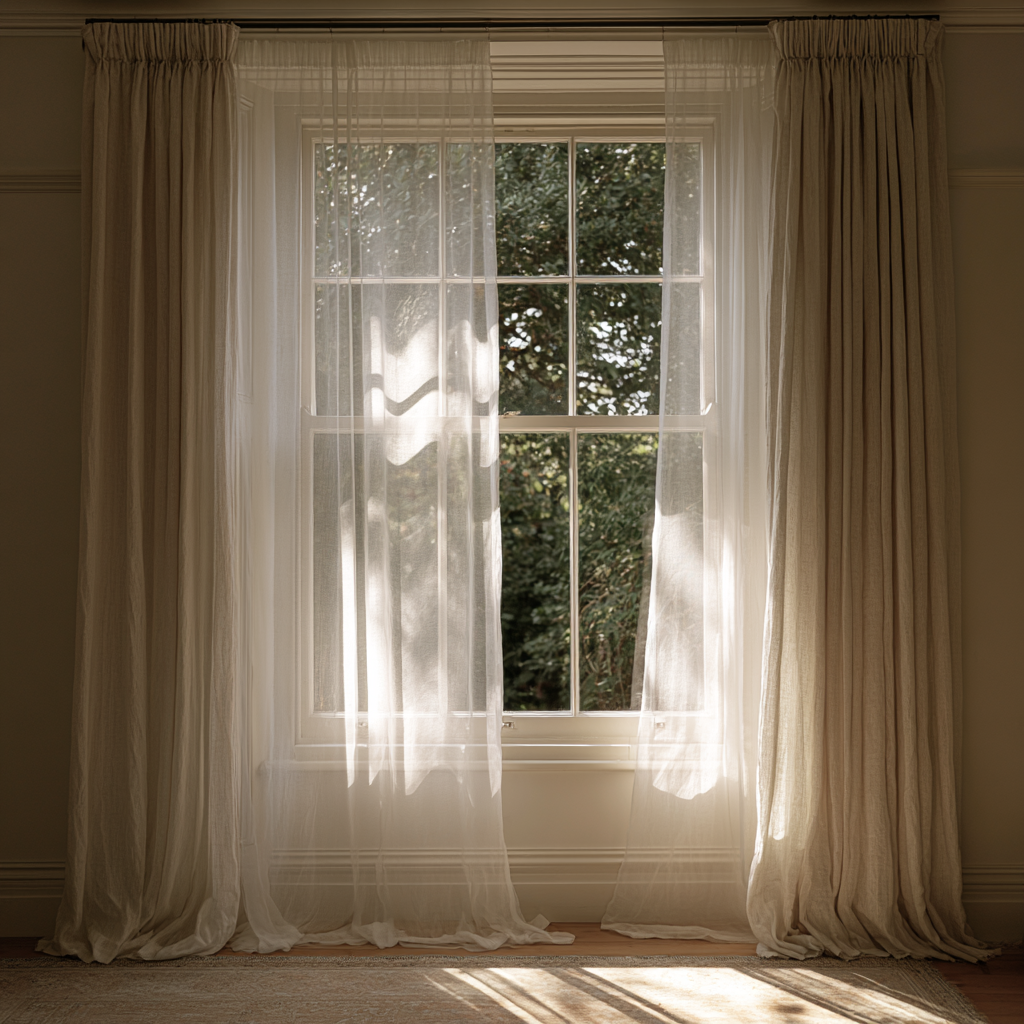
Voile and full length curtains
Double Poles and Double Tracks: Sheers and Curtains Together
A double pole or double track gives you two independent layers on the same window, typically a full-length sheer or voile on the inner track and a curtain on the outer. It is one of the most elegant layering solutions available, and one that rewards a bit of planning.
The sheer layer provides daytime privacy and light diffusion without closing the room down. The curtain layer provides warmth, blackout and the full fabric statement when drawn. Used together, they give you complete control over how the window feels at any time of day.
For this to work well, both tracks need enough clearance from the wall and from each other to operate independently without the fabrics catching. This is where the choice of heading on each layer matters, and more on that below.
One thing worth saying clearly: do not put two eyelet headings on a double pole. The rings of the outer curtain will obstruct the inner, and the whole thing becomes difficult to operate and visually heavy. If you want eyelets on the outer curtain, choose a different heading for the inner layer.

Recess pocket with double curtains
Wave and Pleat Together
Wave heading is one of the most popular choices for a main curtain, and it works beautifully as the front layer on a double track. Because wave heading operates on a track mechanism rather than a pole, it sits neatly and draws smoothly, ideal for a layer that is being used frequently.
The challenge with doubling up on wave is space. Two wave headings on a double track project significantly into the room and the combined stack when open can be considerable. It is not a combination we would recommend.
The better approach is wave on the front track as the primary curtain, the decorative layer, the one that sets the tone of the room, with a simpler heading on the inner track behind it. A pencil pleat tape or a neat, shallow double pleat works well here. These headings take up less depth, stack more compactly and, crucially, this inner layer is usually drawn most of the time anyway, for privacy, light filtering, or to cover a door or window that is not being used. It does not need to be a statement. It needs to be functional and well made, and a good tape or shallow pleat heading does that quietly and efficiently.

Deep Pocket with Two Curtains
Hiding the Layers: Recesses, Pelmets and Curtain Pockets
One of the most common concerns about layering is that it will look busy at the top of the window, too much hardware, too many tracks, a heading that competes with itself.
The solution is to hide it. A deep enough ceiling recess can conceal both tracks entirely, so the fabric simply emerges from the ceiling with no visible mechanism at all. A pelmet does the same job with more design intention, hiding the tracks, the headings and all the working parts, and replacing them with a single clean architectural element at the top of the window. Under a pelmet, the heading on each layer does not need to be decorative at all, which opens up the choice of track and heading considerably.
We covered curtain pockets, pelmets and the practicalities of hiding tracks in detail in our pelmets and lambrequins guide, worth reading if you are at the planning stage of a build or renovation.
Motorisation and Double Layers
Two layers of window treatment on one window means two things to operate, and if both are full length and heavy, operating them by hand every day becomes a consideration worth thinking about.
Motorisation is particularly well suited to layered windows. Each track can be motorised independently, controlled separately and, if the system allows it, programmed to operate together at set times. A motorised wave curtain and a motorised sheer on a double track, both controllable from a single switch or an app, is an arrangement that is quietly transformative to live with. It is also where the investment in a tracked pole or a quality motorised track makes the most sense. The mechanism is doing real work, every day.

Kitchen Window with Cafe Shutters and Roman Blind
Shutters and Curtains, and Shutters and Blinds
Shutters layer differently to soft treatments, and the combinations work beautifully when they are thought through properly.
Shutters and curtains are a pairing that adds warmth and softness to what can otherwise be a slightly hard finish. The curtain needs enough clearance either side of the shutter frame to draw back fully without obscuring the shutter itself, which means the pole or track needs to extend well beyond the shutter on both sides. The curtain is purely decorative here, a frame rather than a functional treatment, and that is exactly the right way to think about it.
Shutters and blinds is a more practical combination, particularly where blackout is needed. A roller blind can be integrated directly into the shutter frame on some systems, sitting behind the louvres and deploying when needed without being visible when not. It is a very clean solution. Where a blind is not integrated, a slim roller blind fitted behind the shutter and within the recess achieves the same result. The shutter provides privacy and light filtering, the blind provides blackout when required.
Shutters and roman blinds need a little more thought. A roman blind needs height above the window to stack when open, typically 20 to 30cm depending on the fabric and heading. If that space is occupied by a shutter frame or a solid head rail, the blind cannot open fully and the shutter doors cannot open at all. The exception is a café style shutter, one that covers only the lower half of the window, where a roman blind above works very well. The blind handles the upper portion of the window, the café shutter handles the lower, and both operate independently without getting in each other's way.
A Few Things Worth Remembering
Every layering decision comes back to space. How much depth there is between the glass and the room, how much wall there is either side, how much height there is above. The most beautifully specified combination will cause problems if the space cannot accommodate it properly.
If you are at the building or renovating stage, layering is exactly the kind of thing worth planning before the walls go up. A recess built to take two tracks, or a ceiling pocket designed to conceal them both, costs very little at build stage and makes everything that follows considerably easier.
If you are working with an existing window, the starting point is always to understand what the space will actually allow, and then choose the combination that works best within it, rather than the one that looks best on someone else's Pinterest board.
Want to Talk It Through?
Layering works best when it is planned as a whole rather than added to incrementally. If you have a window or a room where you want to get this right, we would love to talk it through on a home visit across Hertfordshire and North London.
